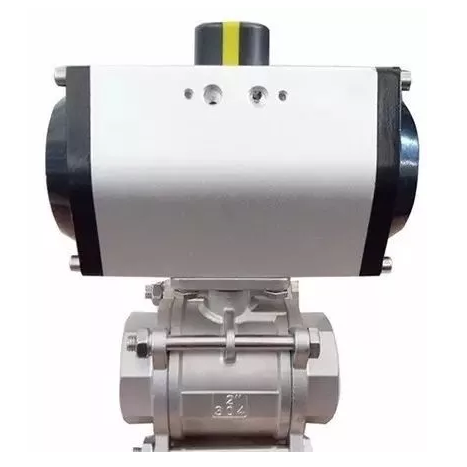
When selecting industrial ball valves, pressure ratings are among the most important specifications to consider. Two of the most common ratings are 600 WOG Ball Valves and 1000 WOG Ball Valves. Although they may appear similar, these valves are designed for different pressure requirements, applications, and operating environments.
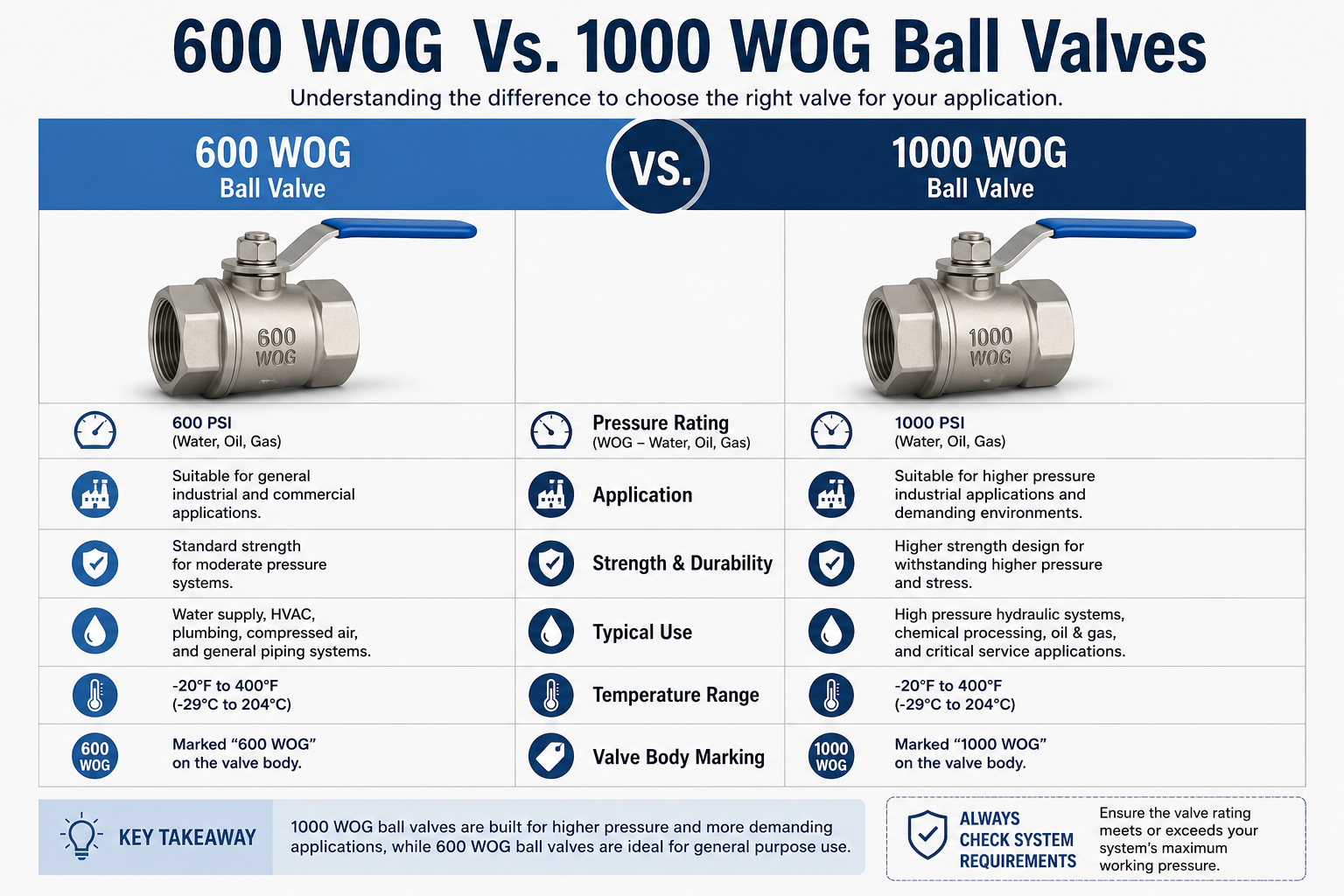
Understanding the differences between these two pressure classes helps engineers, contractors, distributors, and plant managers choose the right valve for long-term reliability, operational safety, and cost efficiency.
What Does WOG Mean?
WOG stands for Water, Oil, and Gas. It indicates the maximum non-shock cold working pressure that a valve can safely handle for these common media.
- 600 WOG = Maximum working pressure of 600 PSI.
- 1000 WOG = Maximum working pressure of 1000 PSI.
The WOG rating applies primarily to room-temperature service. As operating temperatures increase, the valve's pressure capacity generally decreases according to the manufacturer's pressure-temperature chart.
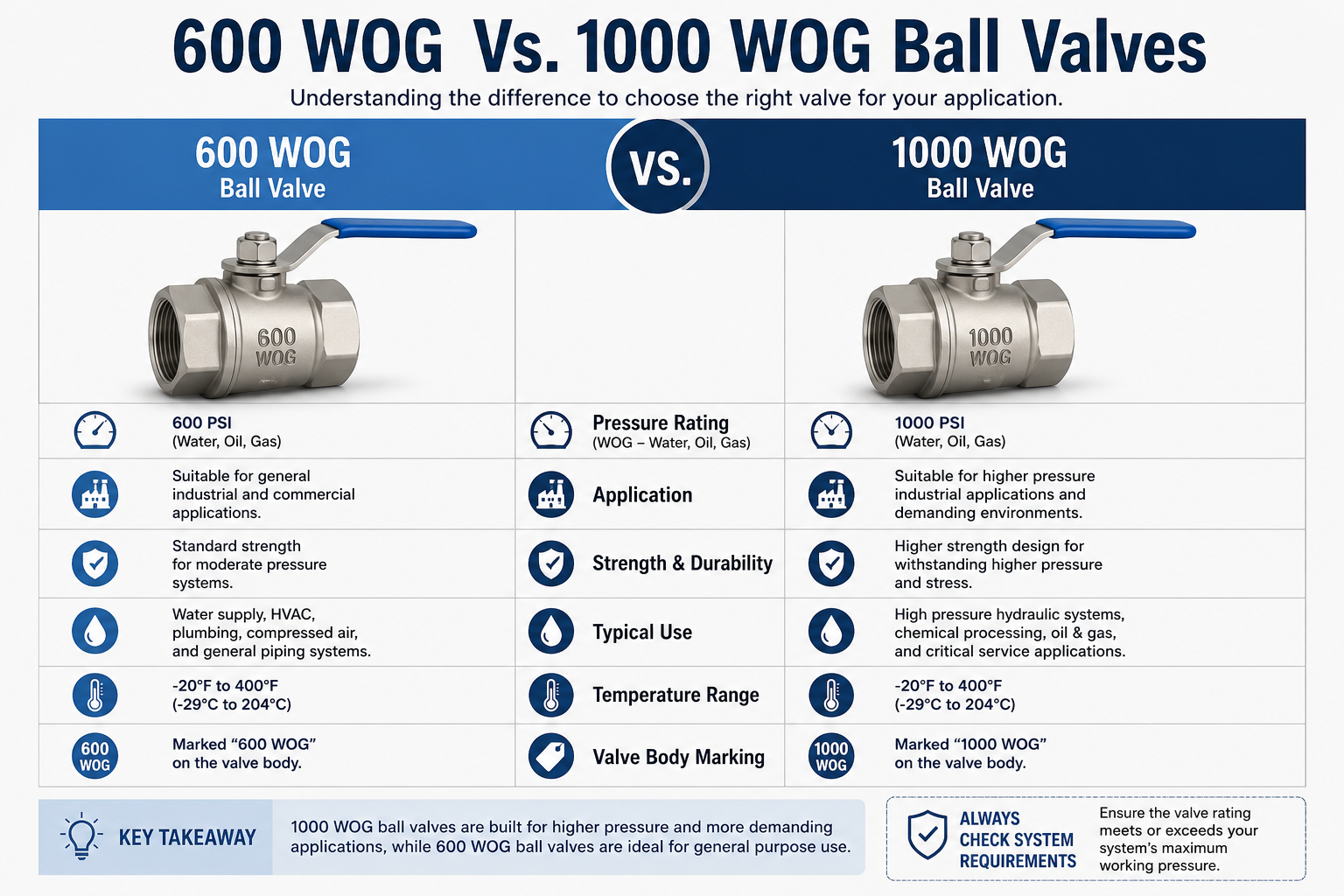
600 WOG Vs. 1000 WOG Ball Valves Comparison
| Feature | 600 WOG Ball Valve | 1000 WOG Ball Valve |
|---|---|---|
| Maximum Pressure | 600 PSI | 1000 PSI |
| Typical Body Thickness | Standard | Heavier Construction |
| Valve Weight | Lighter | Heavier |
| Pressure Safety Margin | Moderate | Higher |
| Industrial Applications | General Service | High-Pressure Systems |
| Cost | Lower | Higher |
Construction Differences
1. Body Design
A 1000 WOG ball valve usually features a thicker valve body to withstand higher internal pressures. The additional material improves structural integrity and minimizes deformation under heavy loads.
2. Ball and Stem Strength
Because of the increased operating pressure, manufacturers often use stronger stainless steel balls, reinforced stems, and upgraded sealing systems in 1000 WOG valves.
3. Seat Materials
Both valve types commonly use PTFE seats. However, premium 1000 WOG valves may incorporate reinforced PTFE, RPTFE, PEEK, or other advanced seat materials for better durability and sealing performance.
Performance Comparison
600 WOG Ball Valves
- Ideal for medium-pressure fluid systems.
- Lower installation cost.
- Suitable for commercial and light industrial applications.
- Easy to operate with lower torque.
1000 WOG Ball Valves
- Excellent performance under high-pressure conditions.
- Improved service life in demanding environments.
- Greater resistance to pressure spikes.
- Higher reliability in continuous-duty applications.
Common Applications
600 WOG Ball Valve Applications
- Water treatment systems
- Commercial plumbing
- Compressed air lines
- General industrial piping
- HVAC systems
- Oil transfer systems
1000 WOG Ball Valve Applications
- Oil and gas production
- Chemical processing plants
- Petrochemical facilities
- Hydraulic systems
- High-pressure industrial pipelines
- Power generation plants
Material Compatibility
Both pressure classes are available in a wide range of materials, including:
- Stainless Steel 304
- Stainless Steel 316
- Carbon Steel
- Brass
- Forged Steel
The material selection depends on fluid compatibility, operating temperature, corrosion resistance, and system pressure.
Advantages of 600 WOG Ball Valves
- Lower purchase cost.
- Reduced installation weight.
- Suitable for most standard industrial applications.
- Lower maintenance expenses.
- Widely available in various sizes.
Advantages of 1000 WOG Ball Valves
- Higher pressure capacity.
- Longer service life.
- Greater operational safety.
- Improved sealing performance.
- Better resistance to pressure fluctuations.
- Excellent reliability for critical applications.
How to Choose Between 600 WOG and 1000 WOG Ball Valves
Choosing the correct valve depends on several engineering factors:
- Maximum operating pressure.
- Operating temperature.
- Fluid type.
- Safety requirements.
- Industry standards.
- Future pressure expansion plans.
- Project budget.
If your system consistently operates below 500 PSI, a 600 WOG ball valve is generally sufficient. However, if the application experiences higher pressure, pressure surges, or future system upgrades, selecting a 1000 WOG ball valve provides a greater safety margin and longer operational lifespan.
Cost Comparison
| Factor | 600 WOG | 1000 WOG |
|---|---|---|
| Initial Cost | Lower | Higher |
| Maintenance Cost | Moderate | Lower over long-term use |
| Replacement Frequency | More Frequent | Less Frequent |
| Lifecycle Value | Good | Excellent |
Frequently Asked Questions
Can a 1000 WOG valve replace a 600 WOG valve?
Yes. A 1000 WOG ball valve can typically replace a 600 WOG valve, provided the valve dimensions, end connections, and material specifications match the piping system.
Does a higher WOG rating improve valve quality?
Not necessarily. A higher WOG rating indicates greater pressure capability rather than overall quality. Both valves can offer excellent performance when properly selected for their intended applications.
Are WOG ratings valid at high temperatures?
No. WOG ratings apply under cold working conditions. As temperatures rise, allowable working pressure decreases according to the manufacturer's pressure-temperature rating chart.
Which valve is better for industrial applications?
For standard industrial systems, a 600 WOG valve is often adequate. For high-pressure, heavy-duty, or mission-critical operations, a 1000 WOG ball valve is generally the preferred choice.
Conclusion
The decision between a 600 WOG Ball Valve and a 1000 WOG Ball Valve should be based on system pressure, operating conditions, safety requirements, and long-term maintenance considerations. While 600 WOG valves provide an economical solution for medium-pressure applications, 1000 WOG valves deliver superior strength, enhanced durability, and increased reliability for demanding industrial environments.
For optimal performance, always verify the valve's pressure rating, material compatibility, temperature limitations, and compliance with applicable industry standards before installation. Selecting the appropriate WOG rating helps ensure safe operation, extended service life, and reduced maintenance costs throughout the lifecycle of the piping system.
If you want to learn more about low-priced products, please visit the following website: www.xm-valveactuator.com