Introduction to 3-Way Switch Wiring
3-way switch wiring is an essential electrical configuration that allows you to control a single light or lighting circuit from two different locations. Whether you want to turn on a hallway light from both ends, control your staircase lighting from top and bottom, or manage outdoor lights from inside and outside, understanding 3-way switch wiring is crucial for any homeowner or electrician. This comprehensive guide will walk you through everything you need to know about 3-way switches, from their basic operation to detailed wiring diagrams.
The term "3-way" refers to the switch having three terminals (plus a ground terminal), enabling the switching functionality between two locations. Unlike standard single-pole switches that have only two terminals and control lights from one location, 3-way switches provide flexibility and convenience in residential and commercial electrical systems.
What is a 3-Way Switch?
A 3-way switch is a type of electrical switch that allows you to control a light fixture from two different locations. Unlike a standard single-pole switch that has two terminals, a 3-way switch has three terminals plus a ground screw. The three terminals are typically labeled as:
- 1.Common Terminal (COM) - This terminal connects to the power source or the light fixture, depending on which switch you're wiring.
- 2.Traveler Terminals (T1 and T2) - These two terminals connect to the traveler wires that run between the two switches.
The switching action occurs between the traveler terminals, allowing the circuit to be completed or interrupted from either switch location. This clever design enables the "three-way" functionality that makes controlling lights from multiple locations possible.
How Does 3-Way Switch Wiring Work?
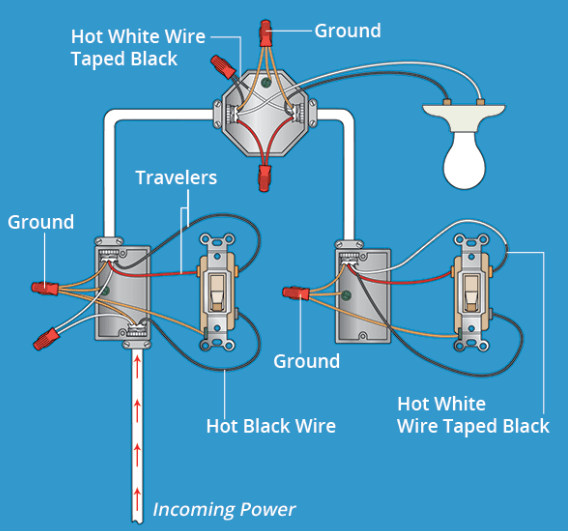
Understanding the working principle of 3-way switch wiring is essential before attempting any installation. The circuit operates on a simple but effective principle:
The Basic Circuit Operation:
1. Power enters the circuit through the hot wire at the first switch.
2. The hot wire connects to the common terminal of the first 3-way switch.
3. Two traveler wires connect the traveler terminals of both switches.
4. The common terminal of the second switch connects to the light fixture.
5. The neutral wire completes the path back to the electrical panel through the light fixture.
6. Toggling either switch changes which traveler is connected to the common, thus completing or interrupting the circuit.
The key to understanding 3-way switch wiring is realizing that both switches work together to control the same light. When you flip either switch, it toggles the electrical path between the two traveler wires, turning the light on or off regardless of which switch you use.
Standard 3-Way Switch Wiring Diagram
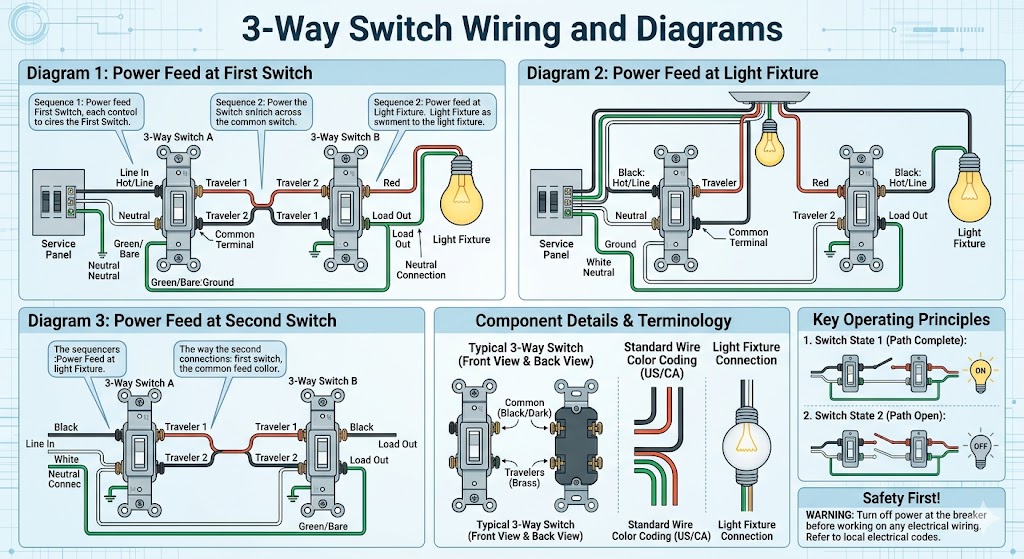
The most common 3-way switch wiring configuration involves running the power source to the first switch, then from the first switch to the second switch, and finally from the second switch to the light fixture. Here's a detailed breakdown:
Wiring Configuration:
Line/Hot Wire: Black wire from circuit breaker → First Switch COM terminal
Traveler Wires: Red and Black wires → Connect T1 to T1 and T2 to T2 between both switches
Load/Light Wire: Black wire from Second Switch COM → Light fixture hot terminal
Neutral Wire: White wire → Runs continuous from panel through box 1 and box 2 to light fixture
Ground Wire: Green or bare copper → All ground terminals connected together
⚠️ Important Color Code Note:
Wire colors may vary by region and installation age. Always use a voltage tester to confirm wire functions before making connections. In older homes, you might encounter different color schemes, so testing is essential for safety.
Alternative 3-Way Switch Wiring Methods
Method 2: Power at Light First
In this configuration, the power source enters at the light fixture location first, then runs to both switches. This method is less common but may be necessary depending on your existing wiring setup.
Wiring Steps:
• Hot wire from panel connects to light fixture junction box
• A 3-wire cable (with ground) runs from light to switch 1
• Another 3-wire cable connects switch 1 to switch 2
• Neutral is available at light box for future smart switch needs
Method 3: Using 4-Wire Cable
Modern electrical codes often require using a 4-wire cable (with an additional neutral wire) between switches to accommodate smart switches and advanced lighting controls. This method provides more flexibility for future upgrades.
• Red wire - Traveler 1
• Black wire - Traveler 2
• White wire - Neutral (required for smart switches)
• Bare/Green wire - Ground
Step-by-Step Installation Guide
Tools and Materials Needed:
✓ Flathead and Phillips screwdrivers
✓ Voltage tester/multimeter
✓ Wire strippers
✓ Needle-nose pliers
✓ Electrical tape
✓ Wire nuts
✓ 3-way switches (2 per circuit)
✓ 3-wire Romex cable
Installation Steps:
1Turn Off Power: Locate the circuit breaker controlling the area and turn it off. Use a voltage tester to confirm power is off before proceeding.
2Identify Wires: Label the existing wires at both switch locations. Identify the hot wire, traveler wires, and neutral wires using your voltage tester.
3Install First Switch: Connect the hot wire to the COM terminal, connect the traveler wires to T1 and T2 terminals, and ground the switch.
4Run Traveler Wires: Ensure the traveler wires are properly connected between both switches, maintaining consistent color coding.
5Install Second Switch: Connect the load wire (to light) to the COM terminal, connect the traveler wires to matching T1 and T2 terminals, and ground the switch.
6Connect Light Fixture: Attach the load wire to the light fixture's hot terminal and the neutral wire to the neutral terminal.
7Test and Verify: Turn the power back on and test both switches to ensure the light responds correctly to both locations.
Common 3-Way Switch Wiring Problems and Solutions
Problem: Light Doesn't Work from One Switch
Solution: Check that the traveler wires are properly connected to matching terminals (T1 to T1, T2 to T2). Don't cross the travelers between switches.
Problem: Switches Work Inversely (One Turns On, Other Turns Off)
Solution: Swap the traveler wire connections on one of the switches. The travelers should be connected identically at both switches.
Problem: Flickering Light
Solution: Check for loose wire connections at all terminals. Ensure wire nuts are secure and no bare copper is exposed. Replace any damaged wires.
Problem: Need Smart Switch Compatibility
Solution: Smart 3-way switches require a neutral wire. You may need to upgrade to 4-wire cable between switches. Some smart switches use add-on modules to work with 3-way configurations.
Safety Precautions and Best Practices
Always turn OFF power at the circuit breaker before working on any electrical wiring.
Use a voltage tester to verify power is off at all wires before touching them.
Follow local electrical codes and obtain necessary permits if required.
Use proper wire nuts and electrical tape for all connections.
Ensure all grounding connections are secure and properly made.
If unsure about any aspect of the wiring, consult a licensed electrician.
Advanced: Converting to 4-Way Switch Circuit
For controlling a light from three or more locations, you need to add 4-way switches between the two 3-way switches. A 4-way switch has four terminals (plus ground) and acts as a crossbar for the traveler wires.
The wiring configuration for a 4-way switch circuit is:
3-Way Switch → 4-Way Switch → 4-Way Switch → 3-Way Switch → Light
Each 4-way switch in the middle takes two pairs of traveler wires and cross-connects them in different patterns depending on its position. This allows the circuit to be controlled from any switch location in the chain.
Conclusion
Understanding 3-way switch wiring is a valuable skill for any homeowner or electrical professional. While the concept might seem complex at first, with proper understanding of the terminal functions and wire routing, anyone can successfully install or troubleshoot 3-way switch circuits. Always prioritize safety, follow local electrical codes, and when in doubt, consult with a licensed electrician. With this comprehensive guide and the wiring diagrams provided, you now have all the information needed to tackle your 3-way switch projects with confidence.
Remember to always test your circuits thoroughly before finishing the installation and consider future needs like smart switches when running new wiring. Proper planning and execution will ensure your 3-way switch installation provides reliable service for years to come.
If you want to learn more about low-priced products, please visit the following website: www.xm-valveactuator.com