Understanding Floating Ball Valve vs Trunnion Ball Valve
In industrial pipeline systems, selecting the correct ball valve design is essential for safety, performance, and long-term reliability. Two of the most widely used designs are the floating ball valve and the trunnion ball valve. Although both are quarter-turn valves that provide reliable shutoff, their internal structures and application suitability differ significantly.
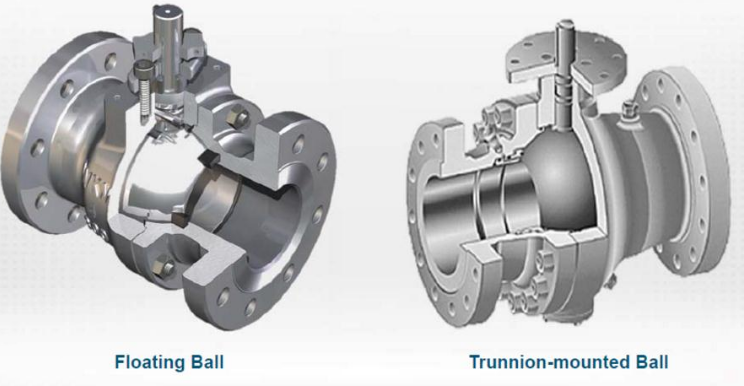
This guide provides a detailed comparison of floating ball valve vs trunnion ball valve, focusing on structural differences, working principles, performance characteristics, and ideal applications.
What Is a Floating Ball Valve?
A floating ball valve features a ball that is not mechanically fixed by a lower shaft. Instead, the ball is held in place by two seat rings and "floats" slightly within the valve body.
How It Works
When fluid pressure enters the valve, it pushes the ball downstream against the seat, creating a tight seal. The sealing performance improves as pressure increases.
Key Characteristics
- Simple structure
- Compact and lightweight
- Cost-effective
- Suitable for low to medium pressure
- Typically used in small to medium sizes
Floating ball valves are commonly used in water systems, chemical pipelines, HVAC, and general industrial applications.
What Is a Trunnion Ball Valve?
A trunnion ball valve has a ball that is mechanically anchored at both the top and bottom by trunnions (support shafts). The ball remains fixed in position, while the seats move slightly to create sealing contact.
How It Works
Under pressure, the upstream seat moves toward the ball, forming a tight seal. The ball does not shift, reducing seat stress and operating torque.
Key Characteristics
- Ball supported by trunnion shafts
- Suitable for high pressure and large diameters
- Lower operating torque
- More complex design
- Higher cost
Trunnion ball valves are widely used in oil & gas, petrochemical, and high-pressure transmission pipelines.
Structural Differences Between Floating and Trunnion Ball Valves
1. Ball Support Design
Floating Ball Valve:
- Ball supported only by seats
- No lower shaft support
- Ball moves slightly under pressure
Trunnion Ball Valve:
- Ball supported by upper and lower trunnions
- Ball remains fixed
- Seats provide sealing movement
This structural difference significantly affects pressure handling and torque performance.
2. Pressure Handling Capability
Floating ball valves are ideal for:
- Low to medium pressure systems
- ANSI Class 150–300 applications
Trunnion ball valves are designed for:
- High-pressure systems
- ANSI Class 600–2500
- High differential pressure environments
For high-pressure transmission pipelines, trunnion design is preferred.
3. Valve Size Range
Floating Ball Valve:
- Commonly used in smaller sizes
- Cost increases significantly in large diameters
Trunnion Ball Valve:
- Ideal for large-diameter pipelines
- Economical for DN200 (8") and above
In large pipeline systems, trunnion valves are more structurally stable.
4. Operating Torque
Floating ball valves:
- Higher torque under high pressure
- Pressure pushes ball tightly against seat
Trunnion ball valves:
- Lower torque
- Fixed ball reduces seat friction
- Suitable for automated systems
Lower torque requirements make trunnion valves easier to automate with pneumatic or electric actuators.
5. Sealing Performance
Both designs can provide excellent shutoff performance.
Floating Ball Valve:
- Strong sealing under moderate pressure
- Relies on line pressure for sealing force
Trunnion Ball Valve:
- Double block and bleed (DBB) capability
- Spring-loaded seats ensure consistent sealing
- Suitable for critical isolation applications
For critical oil & gas isolation systems, trunnion valves are often required.
Application Comparison
When to Choose a Floating Ball Valve
- Low to medium pressure systems
- Smaller pipeline diameters
- Budget-sensitive projects
- Water treatment and general industry
- Chemical transfer systems
When to Choose a Trunnion Ball Valve
- High-pressure pipelines
- Large-diameter systems
- Oil & gas transmission
- High-temperature applications
- Applications requiring double block and bleed
Advantages and Disadvantages
Floating Ball Valve
Advantages:
- Simple design
- Lower cost
- Easy maintenance
- Compact structure
Disadvantages:
- Higher torque at high pressure
- Not ideal for very large sizes
- Seat wear under high stress
Trunnion Ball Valve
Advantages:
- Handles high pressure
- Lower operating torque
- Suitable for automation
- Better for large sizes
- Enhanced safety features
Disadvantages:
- Higher initial cost
- More complex structure
- Larger installation space
Quick Comparison Table
| Feature | Floating Ball Valve | Trunnion Ball Valve |
|---|---|---|
| Ball Support | Seat-supported | Trunnion-supported |
| Pressure Rating | Low–Medium | Medium–High |
| Size Range | Small–Medium | Medium–Large |
| Operating Torque | Higher under pressure | Lower |
| Cost | Lower | Higher |
| Application | General industry | Oil & gas, high pressure |
| Automation Suitability | Moderate | Excellent |
Industry Standards and Certifications
Trunnion ball valves commonly comply with:
- API 6D
- API 608
- ISO 17292
- Fire-safe standards (API 607 / API 6FA)
Floating ball valves are widely used under ANSI and DIN standards for general service.
Conclusion
Understanding the differences between floating ball valve vs trunnion ball valve is crucial for proper valve selection. While floating ball valves offer simplicity and cost efficiency for low- to medium-pressure applications, trunnion ball valves provide superior strength, lower torque, and enhanced sealing for high-pressure and large-diameter systems.
Choosing the right design ensures improved safety, reduced maintenance, and long-term operational reliability.
If you want to learn more about low-priced products, please visit the following website: www.xm-valveactuator.com