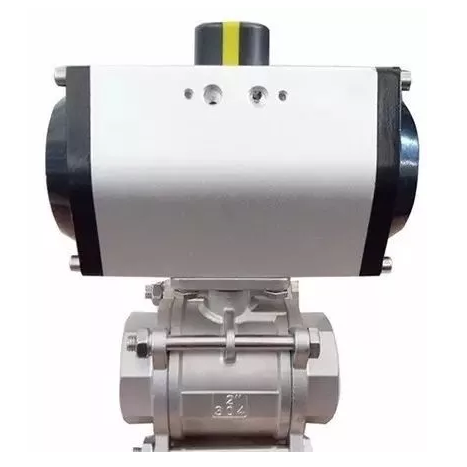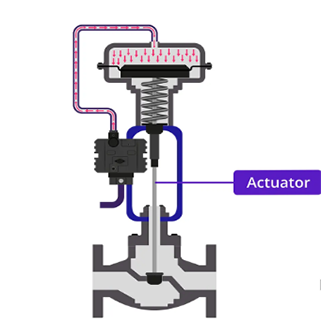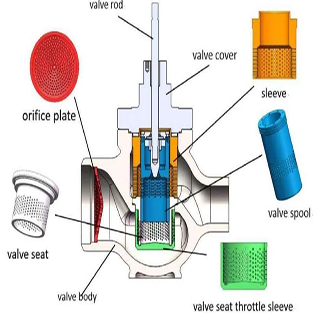
Choosing between rack and pinion and scotch yoke actuators is a critical decision for engineers and procurement specialists in the valve automation industry. The question of torque is central to this choice, but the answer is not as simple as which design produces a higher number. It is about torque output relative to the application demand.
This article provides a comprehensive, technical comparison of these two popular quarter-turn actuator designs. We will analyze their mechanical principles, torque characteristics, efficiency, and application suitability to determine which design offers the right kind of torque for your valves.
Understanding the Mechanisms
Before comparing torque output, it is essential to understand how each mechanism converts the linear force of a pneumatic or hydraulic piston into rotational motion to operate a valve.
The Rack and Pinion Principle
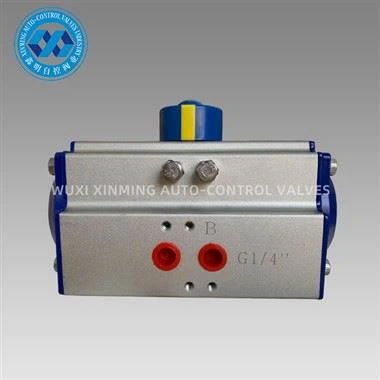
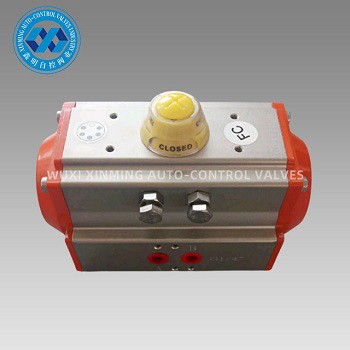
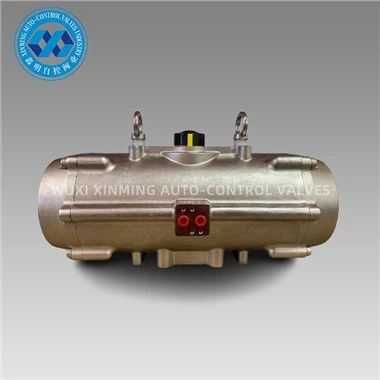
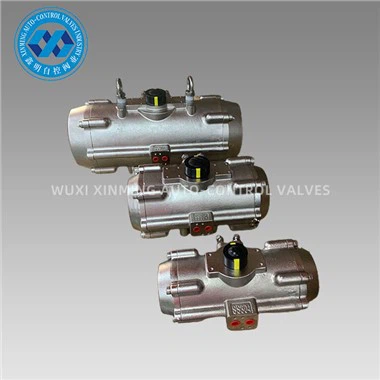
A rack and pinion actuator utilizes a linear piston (or pistons) with a cut gear teeth—the "rack"—which meshes with a circular gear—the "pinion"—attached to the output shaft. As air or fluid pressure moves the piston, the rack slides linearly, rotating the pinion and the output shaft.
This gear-based system creates a constant, linear torque output throughout the entire 90-degree rotation. The force applied to the pinion gear is uniform regardless of the rotation angle.
The Scotch Yoke Principle
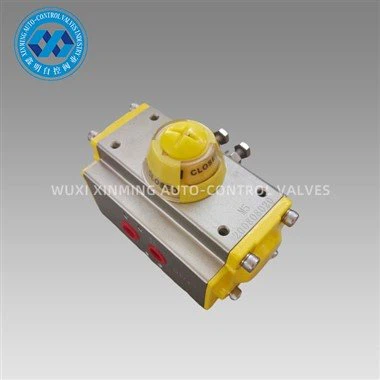
A scotch yoke actuator converts linear motion using a different method. It features a sliding "yoke" with a slot that captures a bearing block attached to the piston rod. The output shaft has a crankpin that slides within this slot. As the piston moves, the crankpin follows the path of the slot, rotating the shaft.
This mechanism operates on the cam principle, which inherently creates a variable (non-linear) torque output. The torque is highest at the beginning and end of the stroke (0° and 90°) and lowest in the middle (around 45°).
| Feature | Rack and Pinion Actuator | Scotch Yoke Actuator |
|---|---|---|
| Torque Output | Constant (linear) throughout rotation | Variable (non-linear), high at ends |
| Key Application | Ball valves, modulating control | Butterfly valves, plug valves |
| Efficiency | Lower torque-to-weight ratio | High torque-to-weight ratio |
| Air Consumption | Higher for equivalent torque | Lower (energy efficient) |
Torque Output Analysis: Constant vs. Variable
To answer the question, "Which design offers higher torque?", we must look at the torque profile of both the actuator and the valve.
Rack and Pinion: The Constant Output
Rack and pinion actuators provide a constant torque value regardless of the valve's rotational position. If a double-acting rack and pinion actuator is rated for 1,000 Nm, it will deliver 1,000 Nm at the start of the stroke (0°), the middle (45°), and the end (90°).
This characteristic makes the rack and pinion design very predictable and simple to size. It is the ideal choice for valves that also require constant torque, most notably ball valves. Ball valves typically have high breakaway torque to unseat the ball, but once in motion, the torque requirement remains relatively stable.
However, when applied to a butterfly valve, this constant output can lead to inefficiency. A butterfly valve requires its highest torque in the first few degrees of opening (0°-10°) to break the disc free from the seat. For the remaining 80° of travel, the torque requirement drops significantly. If you size a rack and pinion actuator to cover the valve's maximum torque (breakaway), it will be oversized and "overworking" for the other 95% of the cycle. If you size it for the average torque, it may lack the power to break the valve open, leading to actuator failure.
Scotch Yoke: The Torque Matching Expert
Scotch yoke actuators offer higher torque exactly where it is needed most. Because of the cam action, the scotch yoke design inherently produces a canted (peaking) torque curve. At the start of the stroke (0°), the mechanism has a mechanical disadvantage, which translates to maximum torque output—often 50% more torque than during the mid-stroke. As the yoke approaches the midpoint, the mechanical advantage changes, and torque output decreases.
This variable output perfectly mirrors the torque requirement of a butterfly valve. The actuator slams the valve open with high breakaway torque and then eases off as the demand decreases. This "torque matching" capability means that for the same valve, you can often select a smaller, more efficient scotch yoke actuator than a rack and pinion unit, saving on cost and energy.
Efficiency and Physical Size
When discussing "higher torque," the conversation inevitably turns to efficiency and physical footprint.
Torque-to-Weight Ratio
Scotch yoke actuators generally offer a superior torque-to-weight ratio. Because the mechanism is robust and leverages the piston force so effectively, it can produce immense torque without requiring massive cylinder bores. For example, a scotch yoke actuator can be 30% lighter than a comparable rack and pinion actuator for the same output torque.
Energy Consumption
The mechanical efficiency of the scotch yoke translates directly to energy savings. Because it requires less pressure to achieve high breakaway torque, and because the center body is often non-pressurized, air consumption is significantly lower. Data shows that for the same torque output (e.g., 480 Nm), a scotch yoke actuator consumes roughly one-third of the air required by a rack and pinion model. The area between the constant torque line of a rack and pinion and the peak torque curve of a scotch yoke in a torque diagram represents substantial "motive energy savings".
Application Suitability and Limitations
Choosing the right actuator based on torque also requires understanding the operational limitations of each design.
When to Choose Rack and Pinion
- Ball Valves: The constant torque output aligns perfectly with ball valve torque profiles.
- Modulating/Control Service: Rack and pinion actuators can hold intermediate positions, making them suitable for throttling applications.
- Compact Envelopes: They tend to have a slightly shorter frame size, which can be beneficial in tight spaces.
- Versatility: They are often easily retrofittable between double-acting and spring-return configurations.
When to Choose Scotch Yoke
- Butterfly and Plug Valves: The high breakaway torque is essential for lifting the disc or plug from the seat.
- High-Torque Requirements: For large bore valves or high-pressure applications, scotch yoke designs can achieve massive torque outputs—ranging up to 100,000 Nm or more.
- Emergency Shutdown (ESD) Systems: The reliability and high initial torque make them ideal for safety applications where valves must close quickly and tightly.
- Cost-Sensitive Projects: For the same torque requirement, the initial purchase cost and the operational energy cost are generally lower for scotch yoke designs.
Note: Standard scotch yoke designs are generally not recommended for throttling service due to the difficulty in holding a mid-point position accurately.
Conclusion
So, which design offers higher torque?
If you are looking for the highest peak torque to break open a stubborn butterfly or plug valve, the Scotch Yoke is the superior design. Its variable torque curve provides a mechanical advantage that delivers maximum force exactly when the valve needs it most, all while being lighter and more energy-efficient.
If you are looking for consistent, reliable, and constant torque throughout the stroke—specifically for a ball valve or a modulating application—the Rack and Pinion is the optimal choice.
The "higher" torque isn't just about the number; it's about delivering the right torque at the right time. Understanding the torque profile of your specific valve is the key to making the correct selection between these two powerful actuator designs.
If you want to learn more about low-priced products, please visit the following website: www.xm-valveactuator.com