In modern industrial automation, selecting the right motion control technology is a critical decision that impacts performance, cost, and maintenance. Actuators—the "muscles" of a system—convert energy into physical motion. But which type is best for your specific application? This guide provides an in-depth technical comparison of Pneumatic, Electric, and Hydraulic actuators.
1. Pneumatic Actuators: The Speed Kings
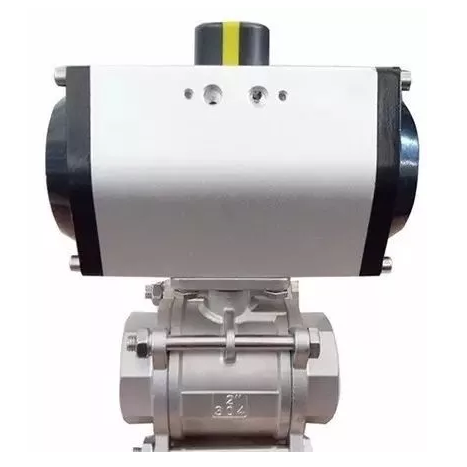
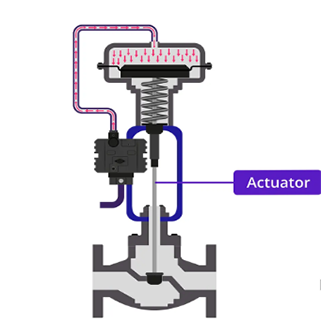
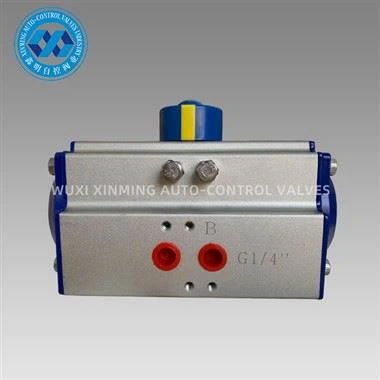
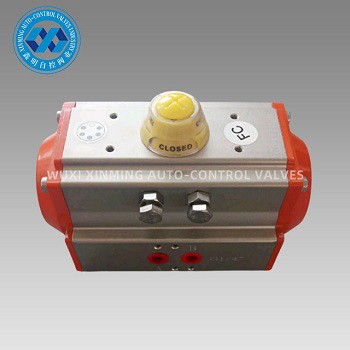
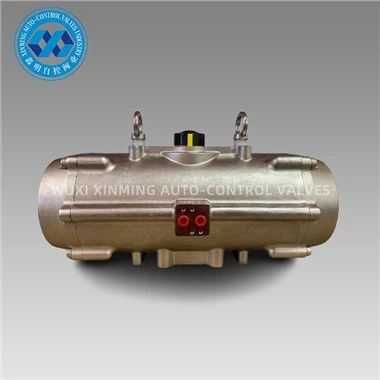
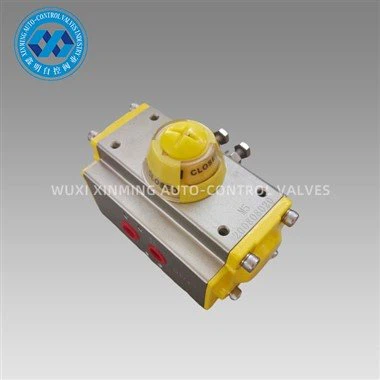
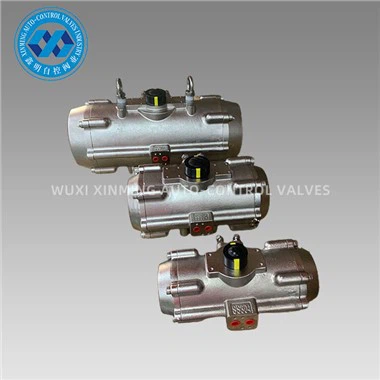
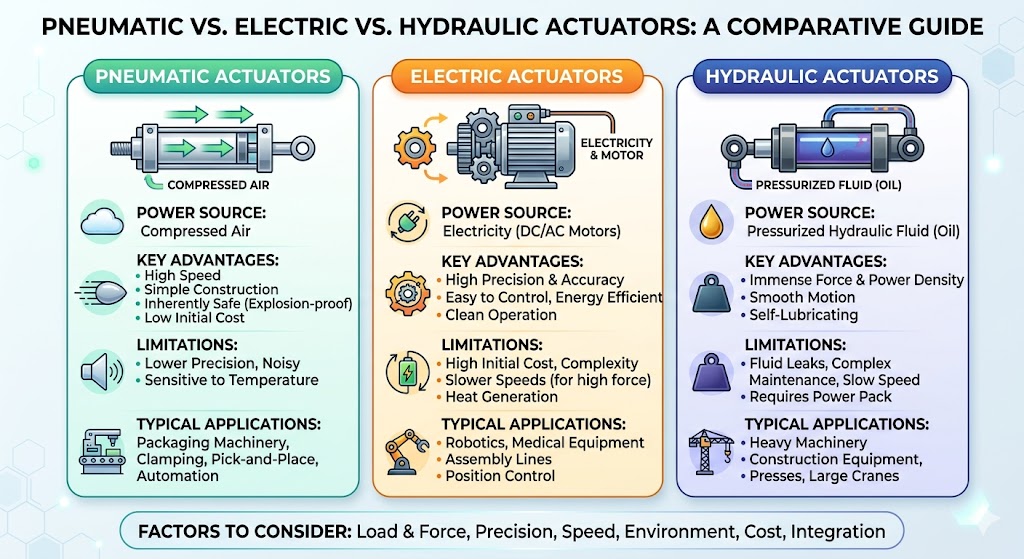
Pneumatic actuators convert compressed air into linear or rotary motion. They are widely used in manufacturing for their simplicity and rapid response times.
Key Advantages:
- Cost-Effective: Lower initial purchase price compared to electric or hydraulic systems.
- Speed: Capable of high-speed cycling, making them ideal for packaging and assembly.
- Durability: Highly resistant to harsh environments, including extreme temperatures and explosive atmospheres (ATEX rated).
Best Used For:
Simple "Open/Close" or "Extend/Retract" operations where precision is less critical than speed and reliability.
2. Electric Actuators: The Precision Masters
Electric actuators use an electric motor (servo or stepper) and a mechanical transmission (like a lead screw) to create motion. They represent the gold standard for Industry 4.0 applications.
Key Advantages:
- Unmatched Precision: Offers micrometer-level accuracy and programmable positioning.
- Energy Efficiency: Only consumes power when moving, unlike pneumatic systems which suffer from air leaks.
- Quiet Operation: Ideal for cleanrooms and laboratory environments.
Best Used For:
Complex automation, multi-point positioning, and applications requiring integration with digital control systems (PLCs).
3. Hydraulic Actuators: The Heavy Lifters
Hydraulic actuators use pressurized fluid (usually oil) to generate force. Because fluid is incompressible, these systems provide immense power density.
Key Advantages:
- High Force Output: Can generate thousands of pounds of force in a compact footprint.
- Constant Force: Maintains full torque/force even when stalled without damaging the motor.
- Smooth Motion: Extremely stable movement even under varying loads.
Best Used For:
Construction machinery, heavy metal stamping, and large-scale valve actuation in oil and gas industries.
Technical Comparison Matrix
| Feature | Pneumatic | Electric | Hydraulic |
|---|---|---|---|
| Energy Source | Compressed Air | Electricity | Pressurized Fluid |
| Precision | Moderate | High (Excellent) | Moderate to High |
| Force/Torque | Low to Moderate | Moderate | Very High |
| System Cost | Low | Moderate to High | High |
| Maintenance | Moderate (Air leaks) | Low | High (Seal leaks/Oil) |
Which One Should You Choose?
Go Pneumatic If:
You need high speed, simple binary motion, and are working with a limited budget in a rugged environment.
Go Electric If:
You require precision, programmable multi-stop positioning, and data feedback for "Smart Factory" integration.
Go Hydraulic If:
Force is your primary requirement. If you need to move tons of material smoothly, hydraulics are the only choice.
Final Thoughts
As we move further into 2026, the lines between these technologies are blurring with the advent of "Hybrid" actuators. However, the fundamental physics remain the same. Evaluating your Total Cost of Ownership (TCO), including energy consumption and maintenance downtime, is just as important as the initial technical specs.
If you want to learn more about low-priced products, please visit the following website: www.xm-valveactuator.com